
A hell of our own making? The bitter ironies of travel.
Rickshaw tours, Britney and Spiderman - the vast juxtapositions of Old Delhi circa 2002. The final installment (for now!) of a three-parter about an ill-fated trip to India.


Monday, 14th October, 2002
Having slept late, we breakfasted in a little cafe and garnered more unwanted attention from a tout who plopped himself down next to us, informing us he was mentioned in the Lonely Planet and insisting we buy cheap train tickets from him — weren’t they all quite cheap? We tried to gently brush him off by saying we’d maybe come find him tomorrow — we wanted to be getting on as we had lots to do. He was persistent. On hearing our broader travel plans, he pooh poohed them, condemning them as rubbish. We finally managed to leave and climbed into an autorickshaw to the National Museum in New Delhi. (Google tells me it’s closed Mondays but that’s what my diary says — odd). As most travel conversations with locals began, our driver noted ‘ah, English?’ and that he knew a place from where he could get us a free map. We had learned by then that NOTHING was free — yet still, he stopped outside another travel place and tried to persuade us to go in. We politely pleaded with him: no thank you, we don’t want a free map, we’d just like to go to the National Museum, please. So through lots of pleading and almost one crash we eventually moved on to our destination. When we arrived, neither of us had the correct change for the R40 fare – only R100 notes – and our driver had no change. So we did a bit of negotiating: he agreed to take us to the Raj Path for an extra R60 and wait for us while we clambered out and took photos of the long boulevard that stretches to India Gate. Despite the time of day, the air was hazy and felt later in the afternoon than it was. He also kindly offered to wait for us when we went to Humayan’s Tomb and take us to Qutb Minar complex and back to the Main Bazaar all for R300 – considering the complex is 14km distant we felt we got quite a good deal – so what looked to be a disastrous morning, turned out to be quite good value for money.
The various ruins, tombs and temples in New Delhi were refreshingly serene, despite the haze and dust, as we caught flashes of green parrots darting from tree to tree and watched seemingly hundreds more of the stripy squirrels we’d seen in the park the day before scurry across walls and up tree trunks. The buildings themselves consisted of a mixture of former and current splendour, religious symbols and beautiful architecture. I remember flashes of this, in a daze - perhaps it was the jetlag kicking in, or a result of the sheer contrast of the surreal calm with the excitement and hyper-vigilance of walking the Main Bazaar. I felt kind of out of time, again, as if I was outside looking in - perhaps exacerbated by the fact of my glasses wearing: as if the literal lenses I saw through provided a barrier of sorts to my perception of reality.
As the day wore on, we’d felt increasingly sorry for our driver as his auto rickshaw was painfully slow: all other traffic sped past us and his engine cut out a few times — no wonder he was desperate to take us all day: no doubt he wanted the money to fix it, so we gave him an extra R50. It was interesting talking to him: he kept saying how pleased he was we’d taken him up on his offer as he had seven younger brothers and one sister and was working in order to be able to afford to study. He said if he had only one brother and one sister like me, he’d be a rich man. It made me feel a little guilty at our initial skepticism of him, but he was just trying to earn a living, not just for him, but his whole family; trying to earn enough cash to support them and give himself an education — what we took for granted (despite the New Labour government’s increase in university fees). We found it hard to discern those who were innocently trying to do their job and be genuinely helpful from those who were trying to fleece us. Always, we were trying to be polite but also walk the fine line between determination and accepting genuine offers of help.
While we enjoyed the sightseeing – it was amazing to see so much rich cultural history and encounter friendly drivers, guides and food sellers – we had to really steel ourselves for the relentless onslaught of physical and verbal abuse from the tourist area where we were staying. The bitter irony of its very existence being due to travellers like ourselves was not lost on us. Interestingly, each time we ventured out of the Main Bazaar in some form of wheeled vehicle we’d pass a huge billboard straddling a building displaying a full length photo of Britney Spears scantily clad in a tight fitting green bikini and shimmering Turkish harem-style tiny pants and twin leg veils (of the kind I saw in Turkish Delight adverts in the early 80s) with a huge yellow albino python draped over her outstretched arms: daring, provocative, highly sexualised. (Funnily enough. ‘I’m a Slave 4 U’, the song this outfit was curated for, came up in an Emkfit video I was exercising to the other day - she knows!) I wondered then, despite our best efforts at wearing loose clothing, our faux wedding rings and polite but brisk manner with unwanted followers, if it was indeed futile when this photo exemplified the predominant, if only, view of white women in Old Delhi at that time. And I am in no way blaming Britney — she was as much of a victim of this as we were then (just look at those lyrics!); but it is an image I didn’t need to google to remember (though I have done so anyway, in case you, dear reader, are not aware of it).

Both upon leaving our lodgings and returning to the Main Bazaar, no one would take no for an answer or let us do our own thing; we couldn’t walk two metres without touts trying to drag us into travel shops or men trying to grope us or just getting pushed out of the way by a sacred cow or an inconsiderate rickshaw. That day, I managed to slap a hand away as it headed for my groin; Julia was not so lucky. And despite the forty five minute journey each way, exposed to the fumes and smog of Delhi traffic – cars streaming past us, honking horns, blocking our way in the while we sat in our laughably slow autorickshaw – I continued to be in awe of this place: everyone was in business mode, including the officious ten year old girls who brought their younger, smaller siblings up to our vehicle at traffic lights to beg or sell their wares. One little boy was selling Spiderman masks that had party blowers attached to the ears so that every time he blew on the mouthpiece, they would dutifully roll out at right angles either side of his head — genius! Our driver, clearly more annoyed than amused, and by now trying to shield us from troublesome chancers, kept explaining to him that we weren’t children so weren’t interested. It was quite tempting though!
Back at Camran Lodge, we went up onto the roof again to watch the sunset and stood amongst the crumbling mosque domes watching it all happen below, removed from the personal attacks and physical assaults, and were able to breathe a little, knowing we just had one more day left until we headed out to Agra. Dinner was a delicious meal of dal and roti for only R85 at one of the cheap outside restaurants; I pointed out how cloudy it was but Julia noted it was just smog. And still we had the same tout hurl further obscenities at us for continuing to decline his services on our way back.
Tuesday, 15th October - our final day in Delhi! (Or so we thought…)
Wanting to explore the ‘real’ Delhi before we left, we hired a rickshaw – early this time to avoid the queues and midday heat – to cycle us around the neighbourhoods of Old Delhi. These turned out to be some of the most deprived areas of the city. We awkwardly sat in a too-small-for-me rickshaw carriage, my legs stuck at uncomfortable angles, back crouched to fit my head in under the low roof making it more awkward still to crane my head around to see out; Julia nestled in her half. We slowly wound our way around busy streets on our wobbly transport trundling over a mixture of pot holes in sealed roads and over stones on dirt tracks, sometimes caught up in traffic (albeit lighter and less fraught than the day before) with hawkers yelling, food frying and horns beeping; stopping and starting — lurching away as our driver stood up to gain momentum on his pedals; watching the different levels of poverty somehow become even more pronounced as we journeyed on: the bright colours of spices and saris of more affluent, vibrant markets dimmed to a depressing brown; buildings shrank from tall advert clad metal structures laced with tangles of black electricity wires to small wooden frames, supporting rusty corrugated sheets of metal; people became more hunched, muted in sound and movement, eyes cast down and occasionally glancing up while we seemingly glided past in our not-so-gilded carriage. I found it hard. My white saviour complex made me feel almost responsible for the sheer level of deprivation we encountered. The contrast of bright colours and jaunty calls for custom from vibrant markets with the bleak brown slums of penury quieted us both and contributed to my burgeoning numbness.
At the end of our ‘tour’ we were dropped off at Paharganj junction so we could buy some fruit from a lively looking seller and were suddenly surrounded by maimed children looking up at us with pleading, leaden eyes and hands – or handless limbs – held out asking for offerings. Across the junction we could see wily eyed adults nudging them towards us. We had read about this: children being purposefully disfigured in order to garner more sympathy from travellers and thereby increase their income from begging. Not wanting to play into the trap of perpetuating this awful situation by giving them money, we gave our fruit to the children instead and tried to extricate ourselves by crossing the busy traffic-filled junction, horns beeping, people shouting, back to the Main Bazaar.
Back in our room, emotionally and physically exhausted from the day, we finalised our packing for the following morning when we would rise early and at last be on a train out of Delhi. Disquieted by the experiences of the day, the guilt and shame we felt of being here, of being wealthy in comparison, wondering if our very presence here was in some way responsible for some of the things we’d seen….? Not wanting to sit in and wallow in our thoughts for the evening, we decided to take up The Lonely Planet and Red Fort guide’s suggestion of going to the sound and light show. Unlike some places mentioned in our travel bible that warned us off going to certain places at night as unaccompanied women, this was fully endorsed and promised to be fun, with fireworks, music and pomp, and had the added bonus of not finishing late allowing us an earlyish night before our train the next day. It seemed a fairly innocuous tourist activity, cheesy though it might be; one to lift our spirits and leave us with a more positive impression of Delhi on our final night. So we thought: why not?
Epilogue
That night, on our short walk in a pedestrianised walkway to the Red Fort, we were attacked by a large group of men and boys. We were sexually assaulted, mugged of our possessions – money belts painfully ripped off our waists – and spent hours at a police station being shouted at by officers before being allowed to call the British Embassy. We never made our train to Agra and were home by Saturday. I am still working on writing the details of that night — when I’m done, I’ll share that too.
Joe, my husband, travelled two years ago to Delhi en route to Udaipur and Jawai on a wildlife photography trip with a friend. He said it’s not at all how I described it now. I don’t know if that’s because twenty one years had gone by or because he’s a man so wouldn’t be subject to the same treatment we were. At forty five years of age, perhaps I wouldn’t be now either.
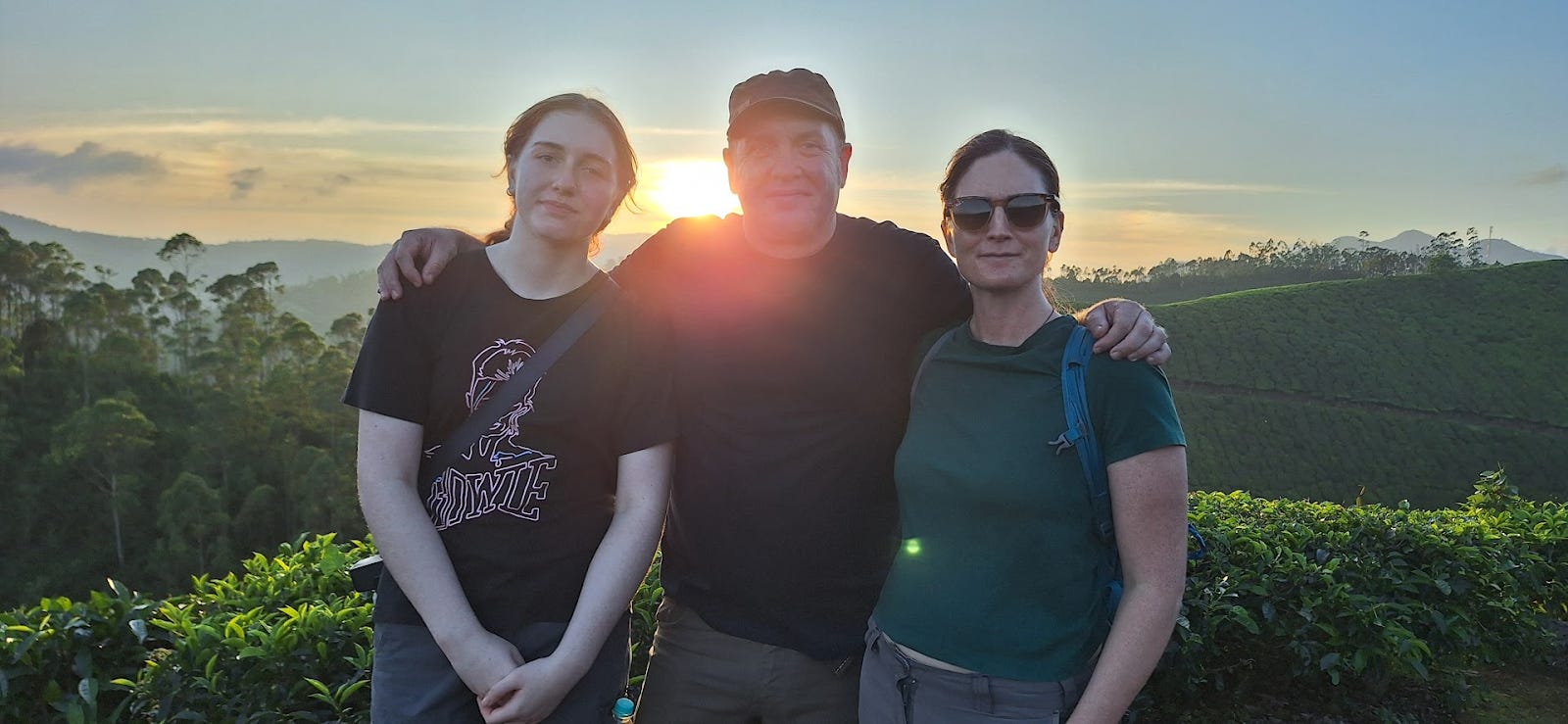
New year just gone, the three of us: me, him and my sixteen year daughter flew to Kochi and travelled around Kerala, joining the many Indian families who holiday on the stunningly serene backwaters of Alleppey, and spent New Year in the tranquil hills of Munnar. It was a welcome tonic to what happened before and was a brief glimpse of what I had hoped to experience during my first time in India. An early riser, in Kochi, I wandered around the streets where we were staying in Jew town as people were making preparations for the day and heading to work and, much like when I wander around residential streets in Thailand, had locals smile and nod, some women chatting with me — and I felt perfectly safe; equally, wandering the old fort area in the early evening with markets buzzing and families strolling the sort-of promenade eating nuts, pakoras and ice cream, any well wishers or hawkers walked alongside Joe, chatting to him, leaving me and Scarlett to walk quietly unnoticed behind.
 | A guest post by
|
Thank you, I know this wasn't easy for you to revisit, you were two of the unlucky ones but hopefully you have cleansed your bad memories revisiting the ghosts and seen as the above reader states, a different, friendlier, India.
Such descriptive writing. Fascinating - but scary too. I’m glad you’ve now found a different, friendlier, India.