
Learning to be present
Revisiting a piece started last year about taking stock and finding delight in suburban nature.


By Katie Sloane
I’m off work today and should be in bed — head pounding, matter congealed behind my eyes, throat lined with razor blades — but the decongestant the doctor gave me has the fun side effect of insomnia: my heart was racing when I was trying to get to sleep last night so I didn’t, leaving me anxious and restless all night, so now I’m wide awake but oh so tired. I heard the household shuffle awake and make its muffled noises as they went off to work and school, so once I’d posted my cover online I thought I might as well walk the dog in a bid to try and induce sleep through physical exhaustion.
And actually, it’s a gorgeous morning. The sun has only just risen above the horizon of low slung houses; at the correct angle, molten yellow pierces long swords of light into the sky — and there’s still some shade. The sky above is a rich dark blue yet even at this early hour of 7:41am on a Monday morning, it is already whitening from the sun’s tropical glare.
I love this time of day — you get much more wildlife, even in this little pocket of suburban Bangkok; it’s breezier, it’s cooler, and you can feel — can you hear that? — little tiny leaves skittering across the road; miniature lemon blades, curled into crisp twists, rolling and playing in eddying whirlpools of wind. It’s a lovely sound of delicate whispers enticing you onward, inviting you to join in their game. Look up, and dappled sunlight spills on garden walls forming tree shadows that slip in and out of focus, varying with the intensity of the sun.
A little old man lives around the corner, slightly stooped, sometimes strapped up in his back support, leaning on his stick, who always greets us with a smiling nod of the head when we pass. When it rains too much, as it does every rainy season, he has to bail out the water from the grounds of his down-set wooden house. I always think of him when the tropical downpours come — the chubby rain lashing so violently that drops bounce hard off the tops of the walls surrounding our house and spring upwards, defying gravity in a complicated water display. I imagine his discomfort, his dread, at the rising water that he’ll, next morning, dressed in over-sized wellies and armed with a bucket, have to lean awkwardly on his walking stick and strain to bend to scoop out the deluge from his low-set garden and onto the road. Does it flood inside his house too? It must do. If the rain’s been really heavy, he uses a wide blue hose, the girth of a large python, to pump it out of his garden creating a little brook of floodwater that glitters in the post-storm sunshine and runs from the road down to the field where the kwai sometimes graze.
He has two dogs, aged, rheumy eyed, and losing their long fur: their tufty bodies are solid and still; their tails slowly wag as we walk past and they stare, panting, happy-looking, slightly unsure of us. One brown and white, is patterned like a Friesian cow; the other is black with longer, curlier fur. In the last year, the black one no longer greets us and now I haven’t seen the other, more friendly one in maybe a month or so? I assumed his wife had died too as she used to totter about with the dogs and I hadn't seen her for quite a while either until one time, maybe a year ago, when she was wheeled out for the afternoon. So maybe she’s bedridden now; maybe she’s passed — I don’t know. But he always smiles and nods in warm greeting when we pass, standing, leaning on his stick, or sitting on a makeshift seat opposite his house, holding his stick before him two handed, like Yoda, under the shade of a papaya tree.
One morning, it must have been last weekend, I saw him perched on a little bench in his garden, tucked in a corner under a pomegranate tree — I wouldn’t ordinarily have known it was there — but I could see him doing his morning exercises: seated and lifting his arms above his head; keeping himself fit so that he can still be agile enough to sweep the leaves that gather in front of his house, and bail water when the rains come.
All these years, I assumed he didn’t speak English — our communication was muted and polite: I'd say, ‘Sawasdee ka’; he'd enthusiastically nod and smile, but the other evening I saw him talking to the tall, wiry Canadian handyman who lives around the corner — hair and posture like Shaggy from Scooby Doo — who has made the makeshift seats for him and tidied the wild area outside his house into a pretty seating area. Well, the Canadian guy was talking to him in English and I assumed he understood. (Unless he was talking at him? It is possible.) When we stopped to say hello, they stopped conversation and the old Thai man reverted to nodding and smiling as the handyman nattered away to me and I assumed they carried on their conversation when I moved on. It reminded me of that scene in Monty Python's Life of Brian when Terry Gilliam’s voiceless and apparently deaf and uncomprehending jailer, once no longer being questioned, turns to his mate and fluently continues with a story he was telling before he was interrupted in clear cut RP — ‘so, as I was saying,...’ All these years I may have been able to have had great chats with him but assumed due to his age, and silent, beaming nods that he didn't speak English.
This morning I can hear all the birds that I normally don’t hear on weekend dog walks as I’m usually too late then. These are the sounds I miss when I'm away and love to hear when I'm back in the country. The almost gibbon-like low and repetitive ‘whoop whoop’ that echoes from the trees; the high-pitched machine gun-like rapid fire of ‘ack ack ack ack’; the long rise and fall, sometimes mournful, sometimes urgent call of the Beer Lao bird — well, a mynah. The sounds of the jungle; the sounds of home. Tiny bee eaters with long curved beaks perfect for siphoning nectar from the heliconia flowers in our garden, and daffodil-yellow bellies, dart from tree to flower, smaller even than the brown sparrows that twitter in small quarrels on the wires, like grumpy teenagers.
The humidity hasn’t yet struck and the sun is building towards, but not yet reached, its full beam of tortuous, blazing power. Right now it reminds me of an English summer sun: warming and comforting without threat of harm; of when I used to lie in it on Felixstowe beach and have the wind sweep over me from the North Sea — welcome, despite its slight chill. Now the breeze is warm — not hot — and feels like I’m being washed with warmth.
I’m trying to be more mindful as I walk and not stare at my phone (often it’s the only time between work, dinner and family that I have to reply to any messages I may have received during the day) and as the temptation is quite strong, overriding the urge to take it out of my pocket is something I’m quite, sadly, proud of. I want to focus on sensory details and be present in the moment: birds calling, cars zooming off in the distance, the yapping or barking of dogs bound to their gardens; sunlight flickering on my eyelashes as it streams through the trees in the early morning, and despite being mostly in shadow, illuminates my eyelashes with momentary golden flickers, strobing my sight and occasionally shattering into a kaleidoscope of colour as the light splits in the prism of fine hair.
A tree shrew darts across the road — it’s hunched back and curly tail question upwards. It pauses, checks I’m not dangerous, and scurries off into a bush. Fern, my gorgeously dapsy mongrel-lab, ex-street dog, is half interested — looks its way — but can’t seem to be bothered: it’s not a cat. I can see the cage of her ribs through her glossy coat, resplendent in her flaxen pelt, shining golden in the morning sun. She sniffs around patches of rogue grass sprouting up in the cracks of the road and trots back to me obediently when I call her away from an approaching car, her claws rhythmically tapping on the asphalt. Often she tries to sniff at or play with an unfamiliar dog, or the ridiculous neighbourhood guinea fowl that lurch and speed off to safety in unfathomable zigzags, like The Muppets’ Beaker (I always expect them to screech ‘meemeemeemeemee’ as they run, their red heads flapping open, muppet-like — but of course they don’t.) Is there any other animal simultaneously as ugly, odd and beautiful? Their plump pied and speckled feathers are tinged with the tiniest slither of striking kingfisher-blue — stunning! Yet topped with that absurd, tiny turkey head.
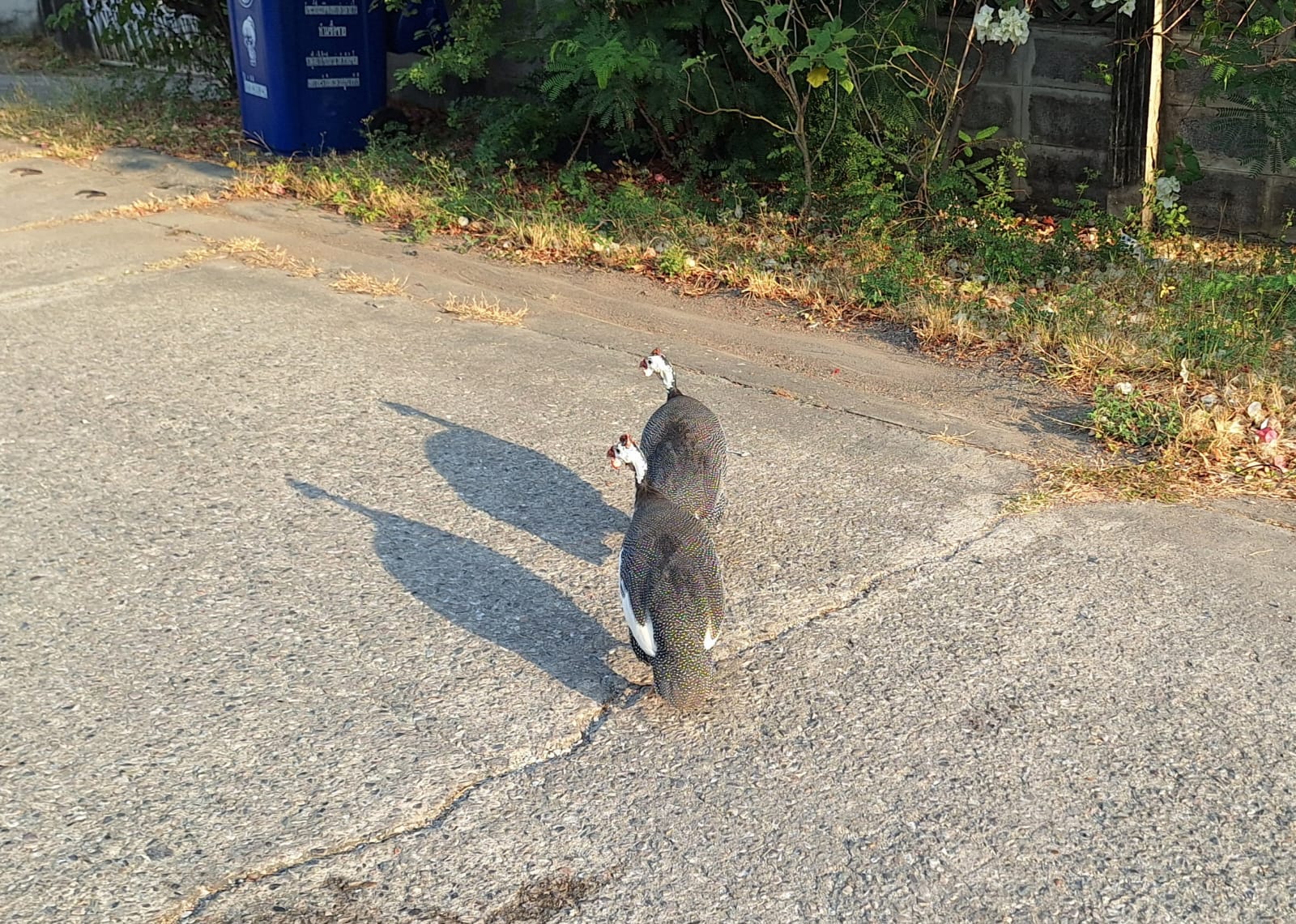
Over the weeks, having watched them grow in confidence around us, sometimes flapping ungracefully up to perch on the corrugated fence that circumnavigate their home — a junk yard where two sweet dogs and innumerable chickens also live — we now only see one. The more skittish yet also apparent leader of the two, told apart by its new fashion of spiky ruffled neck feathers — as if, cartoon-style, someone has grabbed it by the throat in an attempt to strangle it and, in letting go, has left it with this absurdly punk ruff — is no more, it seems. The other now wanders more aimlessly, singularly pecking at bugs and grubs in the wasteland, less wary of Fern, perhaps longing for companionship.
The soi dogs have come and gone over the years too. Molly (our other, smaller, older, more streetwise dog — think Katherine Hepburn in soi dog form: elegant, beautiful, headstrong and fiercely independent — whose aging years means she only comes on evening walks now —she does enjoy a lie-in, does Molly) had an arch nemesis, we nicknamed Howler: a wiry, short haired mongrel, who used to hang around outside the kindergarten howling (hence her given nickname) every time we neared. We would mimic her greeting, imitating werewolves, yowling to the sky in unison, imagining that her daytime baying was her musical way of greeting us and praise her on her singing voice. She went for Molly once, completely unprovoked, biting her firmly on her bum, puncturing her hide with a deep neat hole made by one of her lower canines. We watched her wither away to skin and bone surprisingly quickly. On one walk, one of the last times we saw her, a nearby resident was desperately and vainly trying to get her to eat.
There was the large white bear of a dog who lived in the factory grounds and would also bark as we passed, but with shaggy tail slowly wagging. Towards the end of his life, he shrank in stature, and one, and then both eyes grew milky with cataracts or blindness; then when he barked, he looked momentarily frightened before he could smell us and know we were friends. We’ve not seen him for a while now too.
There are new residents — where the guinea fowl lives there are two small black dogs: one desperately submissive, rolling over immediately to allow Fern to sniff her upturned pink belly; the other, coloured like a Doberman but smaller and with floppy ears and a long black tail, is beautiful with her sleek coat, and a bit more wary. She’s almost fully grown now and after initial beef with Molly, respectfully lets us pass, tactfully moving out of the way so we can sidle pass with no fuss. If Molly’s not with us, she’ll trot over to me and Fern to sniff us before moving off. This morning they sit in the junk yard, watching the world go by, safely content in their own territory.
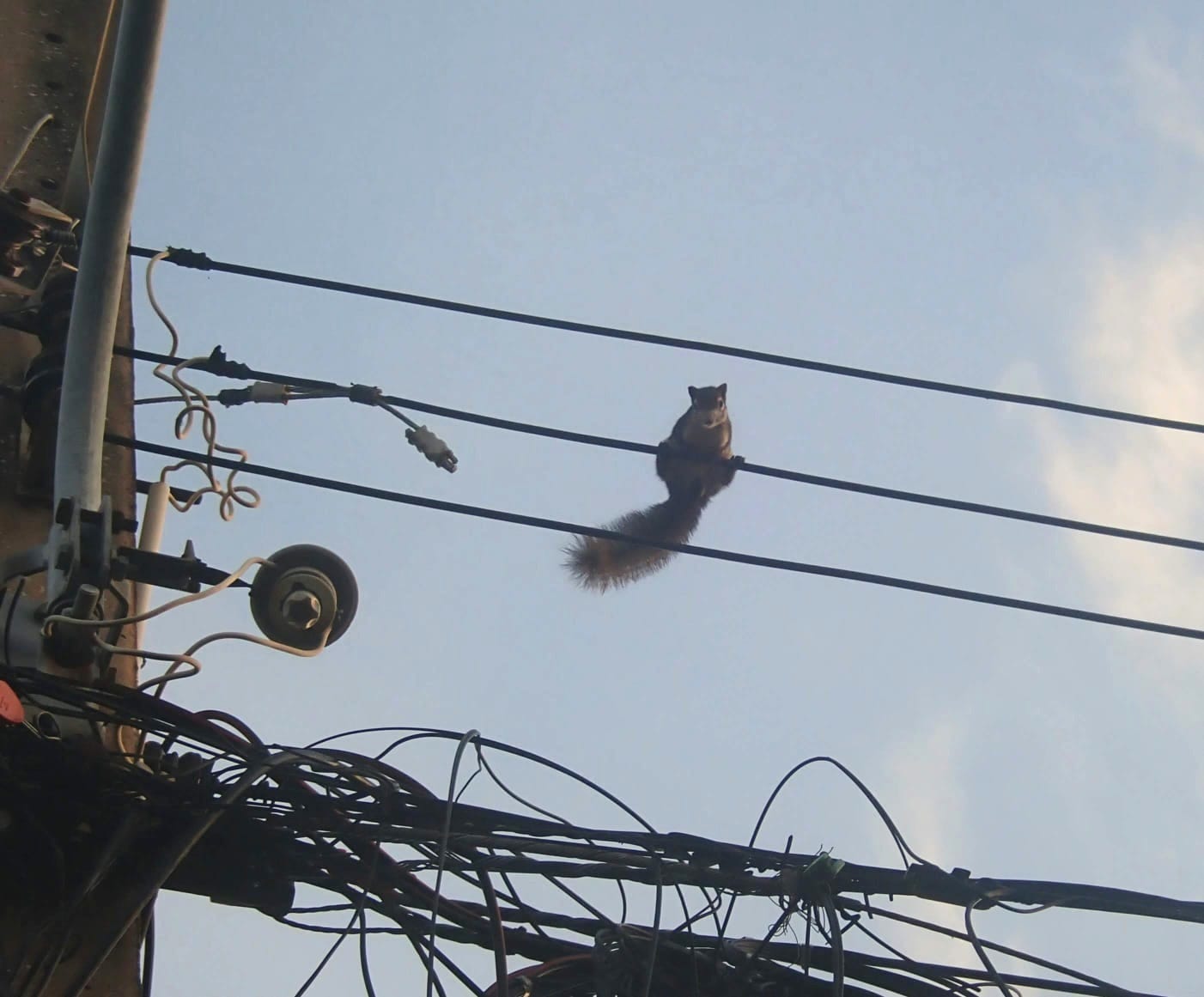
There are more squirrels around in the morning too, to be differentiated from the tree shrews by their rounded heads (tree shrews have pointed triangular shaped faces) and thicker, bushier tails, although some are more sparsely furred, like bottle-brushes. Squirrels never run on the ground, always along the tangle of black electricity wires that line the roadsides and connect houses like satanic Christmas decorations. Often we’ll see a couple chasing each other or meeting almost nose to nose causing one to reach tentatively, perilously, to the wire below. They scamper along the wires, as if in Mission Impossible, before leaping into the trees — wheee!— clutching the branch as it lurches comically with the force of their landing; then they scurry across its limbs and or up its trunk in an impressively chaotic display of rodent acrobatics, our view sometimes obscured by the trees’ leaves. I always like to say ‘hello’ to them when they pass directly overhead — and most of the time they stop and look down at me slightly askance, their beady eyes wondering what I want with them, paws all in one place — forepaws bookending hind — their backs curved in a hump of inquisitiveness, white furry belly on show.
This morning, the trees are just beautiful against the sky: green and blue — my favourite sight. At the end of a swim at the end of the day at work, I’ll often just float for a bit, looking up at the trees against the sky — it is the very definition of peace: seeing the leaves’ pointed tips stretching up to the sky, sheltering me; their soft jagged edges, as if cut with pinking shears, cutting a sharp line between green and blue. Now, as I turn the corner to the kwai’s field, the road is streaked with long early morning shadows; brilliant, bright yellow flowers trumpet to the early morning, pick me, pick me! A tangle of petals invites the bees. Cut grass lies frail — no, lies matted and strewn over the still-living grass. Palm leaves are iridescent in the sunlight: the play of light and shadow they create is captivating; a disco-ball reflection of patterns.
Another advantage of crepuscular dog walks, asides from the cooler temperatures, are the openbill storks. In the evenings, these magnificently large birds cruise overhead, wings stretched languidly, entering the airspace overhead as the light is starting to drain from the sky. We first spotted them in Bangkok skies a few years ago and wondered what they were, these gangly, ungainly birds. It was wonderful to see them in the ‘burbs, to see nature reclaiming this swampland from the clutches of encroaching concrete. Recently, they have been mustering at the top of a mobile phone mast — a tall metallic structure erected a few years ago on the edge of the kwai's field. In the evenings I see them orbit overhead, enjoying following the whims of gentle zephyrs, wheeling blissfully, careening in circles, before, one by one, dangling their comically long legs in a childish V, seemingly far too soon before landing, as if hanging on to an unseen zipwire. When they do finally touch down onto the mast, claws securing their landing, they fold their wings neatly and jostle for space. When the wind has dropped and there are apparently no air pockets to float on, they forego the circling and come into land more smartly, feet stretched out back, gracefully tailing behind, poised, as if showing off to the judges in a gymnastics’ display — ta-da! Looking up there from below, you’d be forgiven for thinking they were some kind of sea-gull/vulture hybrid, hunched up there, awaiting the night — until, as they scramble for a spot, and flap, beat and extend their huge wings, you realise these are not your average sea-birds. The other night I counted fourteen of them up there, silhouetted against a colourless sky, safe from predators, one higher than the rest on the tallest part of the mast, signalling, like Ralph with his conch, that he is their Chief. What sights they must see from there, on top of the world, watching the Chao Phraya snake up from the gulf, around the green lung, through the city proper and disappear to Ayutthaya.
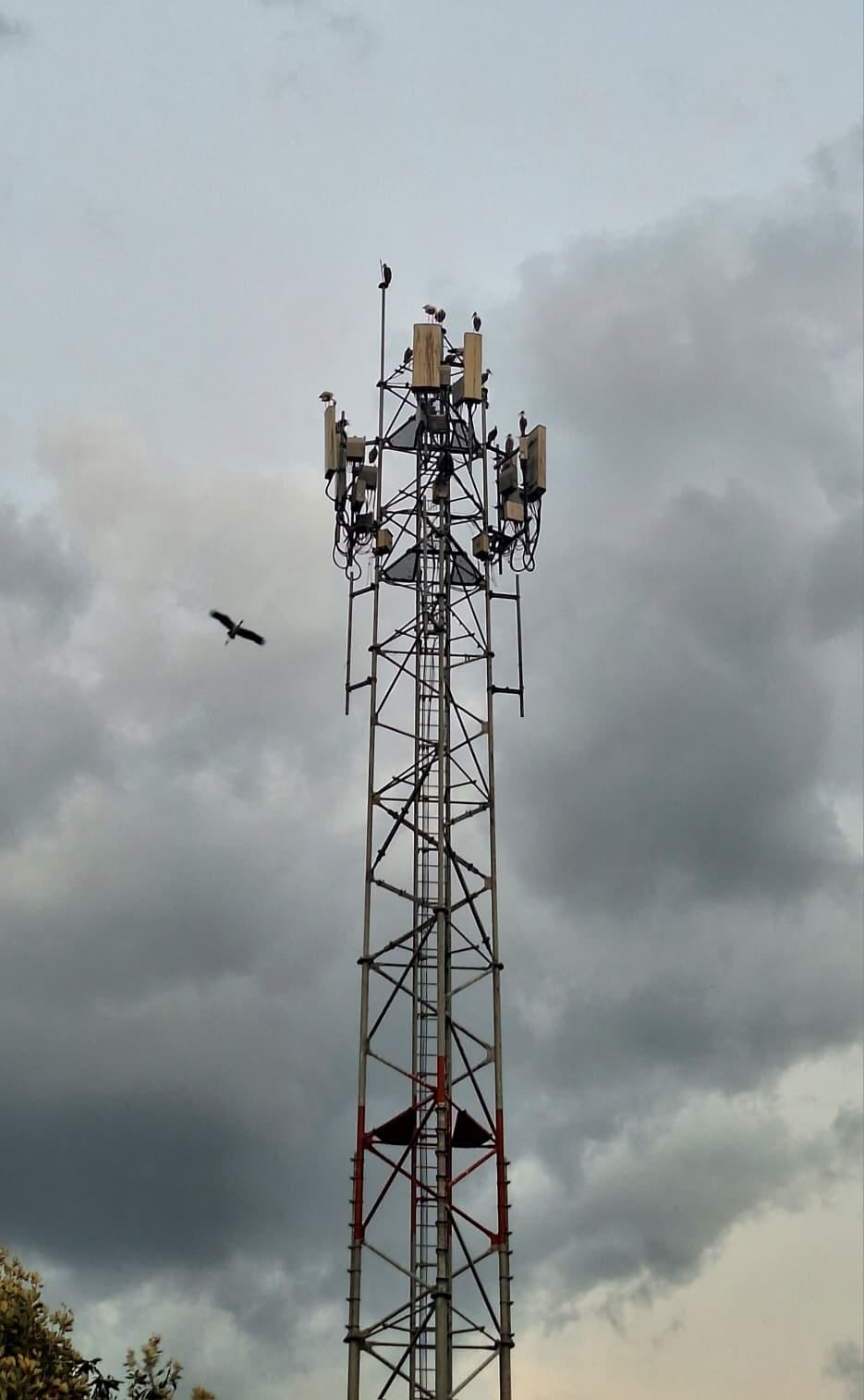
I turn another corner to look for them but I’m too late: these birds have flown. Up at dawn last weekend, I saw them take off one by one and begin their day's journey, wherever it is they go, quietly taking flight and embracing big open air, this phalanx of gracefully awkward pterodactyls.
I start to head back and am struck by the sudden scent of delicate jasmine flowers, the white petals so small that sometimes you can barely see them yet they pack a powerful olfactory punch. They smell so rich, so beautiful — how to describe it? Fragrant, fresh — almost thick, like honey — but not sticky and clagging; more like smooth runny honey and so sweet, almost creamy. And how different to frangipani: their whorled petals tinged with yellow and pink disappear into a slightly furred tunnel of nectar. Jasmine’s scent is delicate, playful and florid like a piccolo scale or an arpeggio; frangipani is heavier, muskier, more seductive, sultry; luring you in.
I lost my sense of smell when my cold/bronchitis bleugh was at its worst a couple of days ago — which was rubbish. It’s weird how the main enjoyment I get from consuming food and drink is smelling it — of course I know that logically but until you experience it, it’s altogether something quite odd. I can’t remember what I had for dinner but I just couldn't be bothered to eat it (and it was something that was usually delicious!) It felt too weird shoving spoonfuls of tasteless mush into my mouth only to be confronted only with its texture and temperature. It felt almost obscene. Without being able to taste it, what was the point? The following morning I had a glass of milk and that was an odd experience too: the thickness of the liquid seemed to line my tongue with a distinctly, almost pleasant, sour tang at the back of my throat. When dog walking that morning I was duly affronting every flower with my nostrils, desperate to discern something; but, alas, to no avail: not even the tiniest note of a scent could I detect until I came to the same jasmine bush I’ve just passed when, almost like the rush you get when you eat too much wasabi, or when water gets up your nose, I had a sudden and momentary whoosh! of fragrance fill my nasal cavities. And then, poof! It was gone again. As if it hadn't happened at all. That fleeting rush of glorious scent filled me with so much joy — there’s hope! It sustained me until my sense of taste and smell returned, thankfully, later that day.
The flowers’ scent is amplified by the early morning and early evening too; I don’t know why, but it’s when it’s at its strongest. I take my fill then, breathing in as much as I can, filling my internal stores with each deep nasal breath, gorging on sensory resplendence to see me through this cold.
And then I’m home. Tired and content, dog satisfied and sleep imminent; the world carrying on its busy Monday routines without me.
 | A guest post by
|
Beautiful, you have the knack of transporting your reader with you on your morning dog walking. I hope you slept well?